
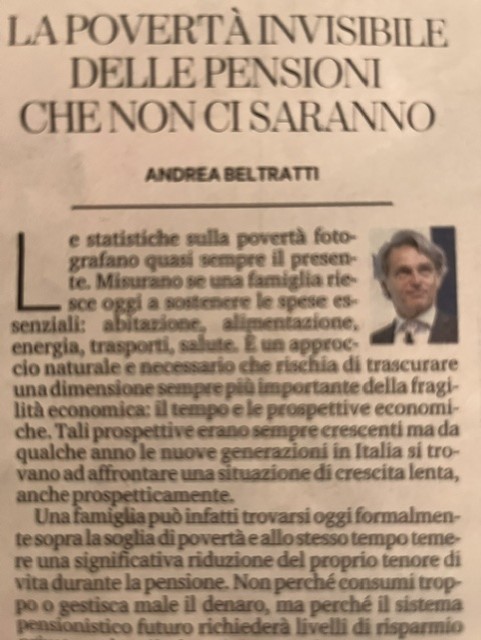
In this article published in the Italian newspaper La Stampa, I discussed the risk of poverty in the future.
Poverty is not only about the present. Without adequate savings and pension provision, many people may face financial difficulties during retirement. This section explores the concept of intertemporal poverty and possible ways to address it.
What is intertemporal poverty?
When we talk about poverty, we normally think about a person’s current economic situation. We look at disposable income, wealth and the ability to meet everyday living expenses.
This perspective is important, but it may be incomplete.
A person may not be poor today and still be financially vulnerable in the future. This can happen when current income does not allow enough savings to be accumulated to maintain an adequate standard of living during retirement.
The concept of intertemporal poverty starts precisely from this idea: economic well-being should be assessed not only today, but over the entire course of a person’s life.
Why is this becoming increasingly important?
In many countries, including Italy, pension systems are evolving towards mechanisms that link retirement income more closely to the contributions actually paid over a person’s working life.
At the same time, life expectancy is increasing, careers are becoming more flexible, and economic uncertainty remains significant.
As a result, for many people future retirement income may be substantially lower than the income they received during their working years.
The difference between these two amounts represents what is commonly called the pension gap.
How can intertemporal poverty be measured?
The basic idea is simple. We compare:
- expected retirement income;
- the income considered necessary to maintain an adequate standard of living during retirement.
If there is a significant difference between these two amounts, savings must be accumulated during working life to bridge the gap. The risk of intertemporal poverty increases when accumulated savings are insufficient relative to the amount required.
A new way of looking at economic vulnerability
Traditional measures of poverty provide a snapshot of the present.
Intertemporal poverty instead attempts to look at the whole movie, considering how income, savings, pensions and longevity interact over time.
This perspective can help individuals, families and policymakers better understand economic risks that accumulate gradually and often become visible only many years later.
An example
Consider a 30-year-old with a net annual income of approximately €23,000, or around €1,900 per month.
According to traditional measures, this person would not be considered poor. Their income is above both absolute and relative poverty thresholds.
The intertemporal perspective, however, introduces an additional question:
Is today’s disposable income sufficient not only to support current consumption, but also to maintain an adequate standard of living during retirement?
To answer this question, we need to estimate:
- future retirement income;
- desired income during retirement;
- the capital required to bridge any potential gap;
- the savings that need to be accumulated during working life.
Applying this methodology to a 30-year-old worker with average characteristics suggests that approximately €2,300 per year — around €190 per month — may need to be saved in order to maintain a standard of living during retirement that is reasonably consistent with that enjoyed during working life.
In this case, the income effectively available for current consumption would not be €23,000 per year, but:
€23,000 − €2,300 = €20,700 per year, or approximately €1,725 per month.
The difference may appear relatively small, but it becomes much more significant for people with lower incomes.
For example, someone with a net income of €1,150 per month might need to save approximately €230 per month to avoid financial difficulties in the future.
Income available for current consumption would therefore fall to approximately €920 per month.
This person might appear today to be just above a minimum poverty threshold, while already being vulnerable from an intertemporal perspective.
This is precisely the idea behind intertemporal poverty: part of current income cannot be regarded as entirely available for consumption if it must be set aside to preserve future well-being.
From this perspective, economic well-being depends not only on the income available today, but also on the ability to preserve one’s economic well-being in the future. Intertemporal poverty therefore considers not only current consumption, but also the savings required for long-term financial sustainability.
An evolving project
This section represents the first step in a broader project.
The objective is to develop educational tools, case studies and indicators that can help measure and understand the risk of intertemporal poverty at different stages of life.
In the future, the project may include simulators, aggregate analyses and an observatory dedicated to monitoring the evolution of economic vulnerability over time.